Your Digitalisation Is about to take off
blank adhesive RFID tag
Revolutionizing Warehouse Management with Cutting-Edge RFID Solutions for Seamless Tracking, Tracing, and Enforcement of Fast-Moving Goods

blank adhesive RFID tag
Radio Frequency Identification (RFID) technology has become an integral part of various industries, providing seamless tracking and management solutions. When it comes to implementing RFID systems, one crucial decision is whether to opt for pre-printed or blank RFID labels. Both options have their own set of advantages and considerations, and choosing the right type depends on your specific needs and goals. In this blog post, we will explore the factors to consider when deciding between pre-printed and blank RFID labels.
Understanding RFID Labels:
Nlay is a special term for RFID industry, which refers to a pre laminated product composed of multi-layer PVC or other materials containing chips and coils. After different forms of packaging, different kinds of RFID tags can be made. Inlay can be understood as semi-finished products without encapsulation of RFID tags. RFID inlay can be divided into dry inlay and wet inlay. RFID Dry inlay does not contain back glue, and its structure is antenna + chip + chip package; RFID Wet inlay contains back glue, which can be directly attached to objects.
Pre-Printed RFID Labels:
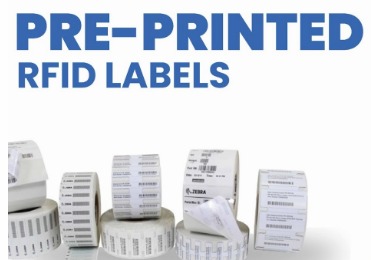
Pre-printed RFID labels come with pre-applied printed information, such as logos, barcodes, and text. This information is often related to the product or item being labeled. Here are some considerations for choosing pre-printed RFID labels:
Consider the following when contemplating blank RFID labels:

Application for Blank Adhensive RFID Tags:
.

RFID Tagging and Identification
Flexibility and Customization:
Blank labels offer the flexibility to print variable data, making them suitable for applications where each item requires unique information.
On-Demand Printing:
Well-suited for scenarios where you need to print labels on demand, allowing for real-time adjustments to the information being printed.
Cost Efficiency for Small Batches:
If your labeling requirements involve small batches or diverse information, blank labels may prove more cost-effective in the long run.
Decision-Making Criteria:
When deciding between pre-printed and blank RFID labels, consider the following criteria:
Volume of Labels:
Assess the volume of labels needed. Pre-printed labels may be more economical for large quantities of identical labels, while blank labels are advantageous for smaller batches or variable data.
Customization Requirements:
Evaluate the level of customization needed for your labeling. If each item requires unique information, blank labels offer the flexibility for on-demand printing.
Implementation Timeline:
Consider the urgency of implementing your RFID system. Pre-printed labels are ready to use, while blank labels may require additional time for printing and application.
Long-Term Cost Analysis:
Conduct a cost analysis that takes into account the initial investment, ongoing consumables, and the expected lifespan of your RFID system. This will help determine the most cost-effective option for your specific needs.
RFID Dry Inlay
Inlay is a special term for RFID industry, which refers to a pre laminated product composed of multi-layer PVC or other materials containing chips and coils.
RFID RFID Wet Inlay


